- The Core
- Posts
- War Reaches Piped Gas
War Reaches Piped Gas
In partnership with

Good Morning. When the war in West Asia first broke out in late February, piped gas users in India seemed insulated compared to those who cook with gas cylinders. After weeks of attacks on major gas facilities in the region, where India imports much of its liquefied natural gas (LNG) from, this stability seems to be under threat. India’s heavy reliance on both fuels and the imbalance between households connected to piped gas and those still dependent on cylinders is what is intensifying the crisis.
The Noida International Airport, after missing several deadlines, is finally set to open on March 28. Once fully running, it will be India’s biggest. And it’s betting on services beyond passenger traffic for its business.
India’s equity indices ended higher on Wednesday. The BSE Sensex closed at 75,273.45, gaining 1,205.00 points or 1.63%. The NSE Nifty50 closed at 23,306.45, gaining 394.05 points or 1.72%.
In other news, the rupee hits yet another low against the dollar. Meanwhile, India tweaks the UDAN scheme for aviation.
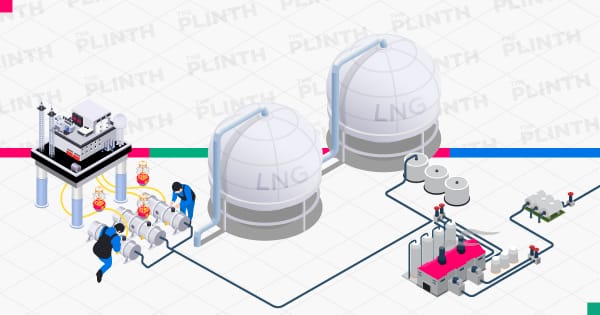
LPG Cylinder Suffering Is Coming For The Piped Gas Consumers
For the first three weeks of the war, it seemed as though India had inadvertently insulated a small fraction of its population. While the Strait of Hormuz closure grounded liquefied petroleum gas (LPG) tanker traffic to a near halt and the government moved to ration household cylinders — extending booking intervals from 21 to 25 days, cutting commercial allocations to a fifth of normal, imposing 45-day refill cycles on rural PMUY consumers — the 1.47 crore households connected to piped natural gas networks cooked on, undisturbed.
Their gas arrived at 21 millibars, through the same buried polyethylene pipes, at the same flame height as always. The crisis, for them, was something happening to other people.
That calm was always more fragile than it appeared. On the night of March 18, when Israeli aircraft struck Iran’s South Pars gas field and Iran’s missiles found their mark at Ras Laffan Industrial City in northern Qatar, the structural underpinnings of piped natural gas (PNG’s) apparent resilience began to crack.
Why The Pipe Seemed Safer
The difference between PNG and LPG households has a clear physical explanation rooted in how the two supply chains are built.
LPG, a blend of propane and butane, must be compressed into a liquid and shipped in specialised pressurised tankers. In 2024, West Asia contributed 97% of India’s total LPG imports, with every cargo transiting the Strait of Hormuz.
When Iran moved to interdict that corridor, the supply chain had no resilience mechanism — no storage buffer between the tanker terminal and the kitchen stove.
The PNG system is structurally different. Natural gas arrives as liquefied natural gas (LNG), chilled to minus 162 degrees Celsius for ocean transport, warmed back into gas at India’s regasification terminals, and fed into the national trunk pipeline grid. The pipeline network itself holds gas under continuous pressure.
When a disruption hits, PNG consumers are insulated by gas already in the distribution grid, transmission pipelines, and LNG storage tanks at import terminals. It’s a buffer measured in days to weeks rather than the number of cylinders in a distributor’s godown.
The scale of India’s exposure to both fuels, and the yawning gap between how many households have the protection of the pipe versus how many remain on the cylinder, is what makes the current crisis so acute.
Every cubic metre of Qatari gas that India cannot receive at contracted rates must now be sourced on the spot market from the US Gulf Coast, Australia or East Africa. The prices are elevated by the same war that destroyed the production capacity in the first place.
India’s government has acknowledged the risk but framed it carefully.

Noida Airport’s Big Bet: High-Stakes Execution In MRO And Cargo
What?
After receiving an aerodrome licence from the aviation regulator, the Directorate General of Civil Aviation (DGCA) earlier this month, the Noida International Airport (NIA) is finally set to be inaugurated on March 28.
Spread over 1,334 hectares, the airport is positioning itself as a regional hub for cargo and maintenance, repair, and overhaul (MRO) services. It expects up to 8 million passengers in its first year of operations, subject to clearing the remaining approvals. The number is expected to cross 70 million once the project is completed over 30 years.
NIA is located in the Jewar sub‑division of Gautam Buddh Nagar district in Uttar Pradesh, India’s most populous state, 72 km from Central Delhi. With its four‑phased development, it will be the country’s largest airport on completion.
Cargo and MRO will be key components of NIA’s growth strategy, as it will be the third airport in the Delhi National Capital Region (NCR) after the Indira Gandhi International Airport (IGIA) and Hindon Airport in Ghaziabad. As the country’s busiest airport, 73.6 million passengers used IGIA in FY 2023‑24, according to data from its operator GMR Airports and the national airport authority Airports Authority of India (AAI).
Why It Matters
While NIA positions itself as India’s first aerotropolis by integrating cargo, MRO services, multimodal connectivity, and integrated township development, its March 28 launch follows a history of four missed deadlines and ongoing daily penalties.
The project’s ultimate success will depend upon overcoming execution risks and coordinating complex regional infrastructure to transform from a delayed construction site into a competitive global aviation hub.
1,000+ Proven ChatGPT Prompts That Help You Work 10X Faster

ChatGPT is insanely powerful.
But most people waste 90% of its potential by using it like Google.
These 1,000+ proven ChatGPT prompts fix that and help you work 10X faster.
Sign up for Superhuman AI and get:
1,000+ ready-to-use prompts to solve problems in minutes instead of hours—tested & used by 1M+ professionals
Superhuman AI newsletter (3 min daily) so you keep learning new AI tools & tutorials to stay ahead in your career—the prompts are just the beginning
$1.78 billion
That’s how much a consortium led by Aditya Birla Group, along with Bennett, Coleman & Co. Ltd. (The Times of India Group), Bolt Ventures and Blackstone, paid to acquire the Royal Challengers Bengaluru (RCB) men’s cricket team. The deal covers both its Indian Premier League (IPL) and Women’s Premier League (WPL) teams.
They bought the franchise from United Spirits Limited (USL), a subsidiary of Diageo plc, for roughly Rs 16,600 crore. The buyers outbid several rival groups, including interest from global investors and Indian conglomerates looking to enter the IPL ecosystem.
Why It Matters: “We see RCB as a long-term strategic investment that brings together sport, media and consumer engagement, with the potential to build a global sports brand,” Kumar Mangalam Birla, chairman of the Aditya Birla Group, said.
The sale stands out because it sets a new benchmark for IPL franchise valuations, pushing teams firmly into the billion-dollar club. It also signals rising global investor appetite for cricket, as private equity and media players chase the league’s fast-growing revenues.
Outcome: RCB commands one of the largest fanbases in the IPL, driven by consistent star power, especially Virat Kohli, and a strong digital presence. Despite limited title wins, the franchise has built a loyal, nationwide following that translates into high engagement, sponsorship value and commercial appeal.
Crisis Reshapes India’s Economy
The escalating West Asia conflict has triggered a radical shift in global energy strategy as crude prices surged past $100 a barrel. To secure domestic supply, India has reportedly received its first cargo of Iranian LPG in years following a temporary easing of US sanctions. This shipment, shared by IOC, BPCL, and HPCL, was settled in rupees— part of a broader move by Indian refiners to bypass the dollar.
Similar alternative currency settlements, including the UAE dirham and Chinese yuan, are being utilised for Russian oil purchases ahead of a looming April 11 US waiver deadline, Bloomberg reported.
Catch Up Quick: On the domestic front, the government has moved from persuasion to mandate to insulate households from import volatility. A new order stipulates that LPG supply will be discontinued for urban consumers who fail to switch to Piped Natural Gas (PNG) within three months, where connectivity is available.
While the regional outlook remains tense, rare signs of diplomacy have emerged. Reports indicate Pakistan has delivered a 15-point US de-escalation framework to Tehran, with Turkey or Pakistan proposed as potential summit venues, Reuters reported.
Future: A latest report from Bernstein warns of "catastrophic" repercussions if the West Asia conflict persists through 2026. In a worst-case scenario, India faces double-digit inflation, a collapse in GDP growth to the 2–3% range, and the rupee plunging past 110 against the dollar. With Nifty projected to slide well below 20,000, analysts caution that the resulting high interest rates would effectively stifle credit recovery for several quarters.
Green Shift Meets Friction
India has delayed its plan to mandate coal-fired power plants to lower output during peak solar generation by one year, Reuters reported, citing documents it has reviewed. Regulators are still finalising compensation for the higher maintenance and retrofitting costs required to cut minimum utilisation rates from 55% to 40%.
Overview: While the Central Electricity Authority (CEA) notes that flexible coal is ten times cheaper than battery storage, state operator NTPC warned of accelerated equipment wear. Analysts warn that this delay threatens renewable investments and increases emissions.
Setup: The Core earlier reported how transmission delays trigger massive power waste. This setback contrasts with China, which has successfully reduced coal utilisation to as low as 25% to prioritise green energy.
Intervention Hangover Hits
The rupee closed at a record low of 94.05 per dollar, as persistent dollar demand and foreign outflows outweighed easing oil prices.
Backdrop: Pressure on the currency has intensified due to maturing offshore forward contracts, which are forcing banks to buy dollars in the spot market. At the same time, foreign investors continue to pull money out of Indian equities, adding to demand for the US currency. Even as crude prices fall and domestic equities rise, the rupee has failed to recover.
Flashpoint: The Reserve Bank of India is intervening intermittently to limit volatility, but analysts expect the currency to remain under pressure in the near term as these combined forces persist.
UDAN 2.0 Takes Flight
Union Minister Ashwini Vaishnaw on Wednesday announced a revamped UDAN scheme with a Rs 28,840 crore outlay spanning FY27–FY36. The modification shifts focus toward upgrading 100 existing airports and 200 helipads, prioritising hilly, Northeast, and island regions. Notably, the plan eschews greenfield projects in favour of brownfield infrastructure and public-private partnerships.
Context: To tackle high operational costs, the government will provide Rs 10,043 crore in Viability Gap Funding (VGF), offering 80–90% support for airlines over five years. An additional Rs 2,577 crore is earmarked for operations and maintenance to ensure long-term sustainability.
Setting: This overhaul aims to address the ghost airport legacy of the 2016 scheme. While infrastructure was built in locations like Kailashahar, Muzaffarpur, and Azamgarh, commercial viability often remained grounded. The new 10-year roadmap aims to finally bridge the gap between ribbon-cutting and consistent flight operations.
Attio is the AI CRM for modern teams.

Connect your email and calendar and Attio instantly builds your CRM. Every contact, every company, every conversation — organized in one place. Then ask it anything. No more digging, no more data entry. Just answers.
The Markets Rise for the Second Day
On Episode 831 of The Core Report, financial journalist Govindraj Ethiraj talks to Garima Kapoor, Economist & Executive Vice President at Elara Securities (India) as well as Ayaz Memon, Sports Writer and Commentator.
The markets rise for the second day as oil prices fall on peace manoeuvres.
Influential voices in the US like Blackrocks Larry Fink want Iran to be neutralised. What does that mean?
A month into the war, what has and will be the impact on India’s economy. Breaking it down.
Royal Challengers Bengaluru and Rajasthan Royals to Find New Owners.
OpenAI to dump Sora in a sign of rising AI costs and resources.

✍️ Zinal Dedhia, Kudrat Wadhwa, Shubhangi Bhatia | ✂️ Rohini Chatterji | 🎧 Joshua Thomas, Vishnu Rajeev
🤝 Reach 80k+ CXOs? Partner with us.
✉️ Got questions or feedback? Reach out.
💰 Like The Core? Support us.