- The Core
- Posts
- Opportunity, Risk And The India Execution Gap
Opportunity, Risk And The India Execution Gap
The Weekend Playlist
In partnership with

Good morning.
This week’s playlist travels from outer space to the IPO market, then swerves through market volatility before landing in India’s jobs crisis.
The common thread? Big opportunities are everywhere but fault lines are emerging alongside.
Alexandra Vidyuk outlines the commercial potential of space-led innovation, while Neha Agarwal points to a strong but more selective IPO environment. Prateek Agarwal and Aashish Somaiyaa examine how investors should approach volatility in 2026, and Rosa Abraham highlights the structural stress in India’s labour market.
Together, they show that India’s opportunity remains significant, but execution, pricing, productivity, and inclusion will determine its durability.
WEEKEND EDITION
Is The Biggest Market Risk In 2026 Staying Too Cautious?
Market risk is usually framed as something investors must avoid. But what if the bigger risk in 2026 is being too cautious when opportunity is quietly building?
In this Weekend Edition conversation, Govindraj Ethiraj speaks with fund managers Prateek Agarwal of Motilal Oswal Asset Management Company and Aashish Somaiyaa of WhiteOak Capital Asset Management, on why they remain positive on Indian equities despite a long list of worries: oil shocks, FII selling, rupee weakness, gold and silver volatility, AI disruption and global uncertainty.
The argument isn’t that the risks are unreal. It is that markets may already be pricing in a fair amount of fear.
The conversation moves beyond daily market noise to how professional investors think about risk, asset allocation, investor behaviour, and market extremes. India is dealing with macro pressures, but its long-term case—earnings growth, consumption, financialisation, and domestic capital—remains intact. Meanwhile, parts of the US market may be pricing in more optimism than emerging markets.
What emerges is a more nuanced view of volatility. For investors, 2026 may not be about choosing between fear and greed, but between reacting to headlines and identifying where risk has been mispriced.
Why This Matters
If volatility is treated only as danger, investors may miss the next cycle of opportunity. The real edge in 2026 may lie in separating temporary fear from permanent damage.
SPECIAL EDITION
Why India’s IPO Rush Is Getting Harder To Ignore
After a record year of listings, India’s IPO pipeline is still swelling. But is India’s IPO pipeline strong enough to power through 2026?
In The Core Report Special Edition, Govindraj Ethiraj speaks with JM Financial’s Neha Agarwal, on why 2026 could still be a strong year for India’s primary markets, even after a record 2025. Agarwal says the bigger shift is not just the size of the IPO pipeline, but the depth of domestic capital now supporting it. Indian mutual funds, insurers, HNIs and family offices are no longer waiting for foreign portfolio investors to validate deals. They are underwriting India’s growth story themselves.
But this is not a repeat of the excesses of the last cycle. Investors are becoming more selective. They want profitable growth, stronger cash flows, credible management teams and more realistic pricing. The next wave of listings could come from financial services, renewable energy, REITs, INVITs, data centres, precision manufacturing and defence.
Agarwal also points to a possible revival of product innovation, including Indian Depository Receipts, as domestic capital matures.
A Key Insight
India’s IPO market is no longer just a liquidity window for exits. It is becoming a test of whether companies can convert ambition into disciplined, cash-generating growth.
NASSCOM CONVERSATIONS
The Emerging Economics Of Space Innovation
In the latest episode of Nasscom Conversations, Govindraj Ethiraj speaks with Alexandra Vidyuk of Beyond Earth Ventures, who explains why the next wave of innovation may be built in space.
Space-based data centres could one day ease the energy burden of AI infrastructure. Microgravity labs may unlock new materials, better vaccines, and pharmaceutical breakthroughs that are hard to produce on Earth. Satellite intelligence is already reshaping ocean monitoring, logistics, climate risk, and financial decision-making.
Vidyuk also explains how venture capitalists look at deep tech and space startups: not as science projects, but as businesses with defensible technology, clear customers, and real commercial pathways. The episode touches on next-gen GPS, perovskite solar cells, AI-powered satellite data, and India’s opportunity in space-led ocean intelligence.
A Key Insight
The space economy will be won by founders who can translate space’s unique conditions into cheaper, faster, or better solutions for industries on Earth.
THE CORE QUIZ
Sun Pharmaceutical Industries announced the acquisition of which US-based company? |
HOW INDIA’S ECONOMY WORKS
Decoding India’s Wage Growth Problem
India’s jobs problem is often framed as an unemployment problem. But what if the deeper crisis is that even employment is no longer delivering rising incomes?
In the latest episode of How India’s Economy Works, Puja Mehra speaks with Rosa Abraham, economist and one of the authors of the State of Working India 2026 report, about the stress building inside India’s labour market. Recent worker protests in Noida are one visible sign of a broader problem: real wages have stagnated, and in some cases declined, even for formal sector workers.
The issue is not just a weak hiring cycle. Abraham argues that India is facing a structural jobs challenge shaped by low productivity, poor capital allocation, weak enforcement of minimum wages, and the absence of a strong small and mid-sized enterprise base that can invest in workers and create pathways for growth.
Higher education is not solving the problem either. Many young graduates are finding that degrees no longer guarantee better jobs, higher salaries, or economic mobility.
What emerges is a warning about India’s demographic dividend. Growth may continue, but without better jobs and rising wages, its benefits will remain unevenly distributed.
Why This Matters
If India cannot turn education and employment into higher earnings, its workforce advantage could become a source of social and economic strain.
MESSAGE FROM OUR SPONSOR
Your next great hire lives in Slack.
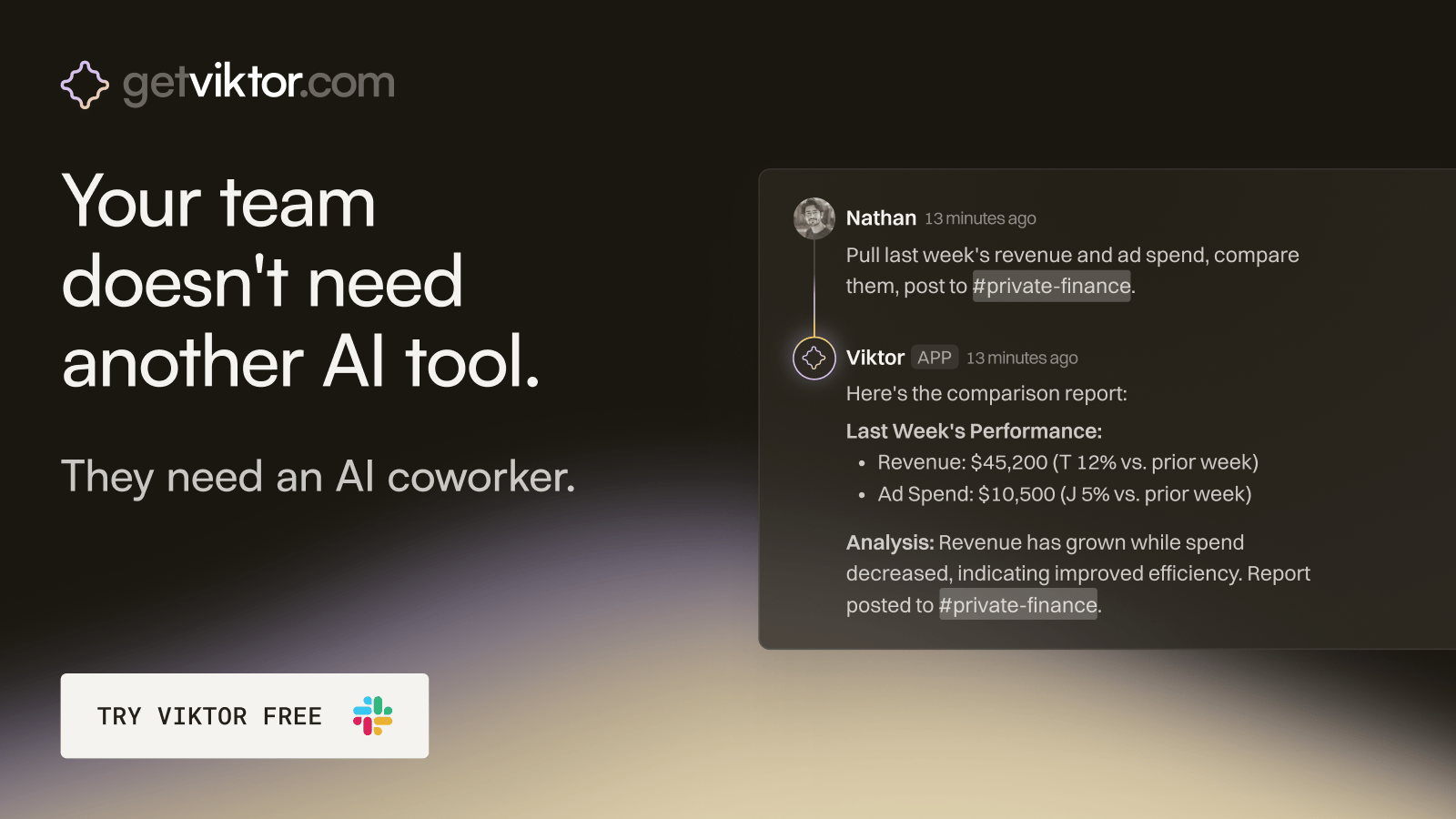
Viktor is an AI coworker that connects to your tools and ships real work. Ask Viktor to pull a report, build a client dashboard, or source 200 leads matching your ICP. Most teams hand over half their ops within a week.
Want to get the most out of ChatGPT?

ChatGPT is a superpower if you know how to use it correctly.
Discover how HubSpot's guide to AI can elevate both your productivity and creativity to get more things done.
Learn to automate tasks, enhance decision-making, and foster innovation with the power of AI.
THE TEAM
✍️ Zinal Dedhia, Kudrat Wadhwa | ✂️ Rohini Chatterji | 📹️ Manjoosha, Maitrayee Iyer | 🎧 Joshua Thomas
🤝 Reach 80k+ CXOs? Partner with us.
✉️ Got questions or feedback? Reach out.
💰 Like The Core? Support us.