- The Core
- Posts
- IndiGo Chaos Drags
IndiGo Chaos Drags
In partnership with

Good Morning. Who's to blame for the IndiGo chaos? While the media has been going after the CEO, the aviation regulator, and even questioning the aviation ministry, one man, who should be held accountable, seems to be missing in action. Rahul Bhatia remains unseen, unheard, and curiously untouched.
In other news, India’s green power capacity is now as much as half of the installed capacity, and the government has hit its target ahead of expectations. Meanwhile, trade uncertainty is not holding back tyremaker CEAT’s global ambitions.
IndiGo Is No Infosys
Indian business is currently witnessing a blame-shifting exercise of unprecedented intensity.
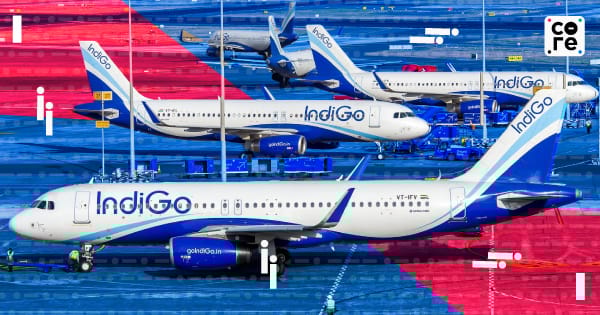
At the centre is IndiGo, an airline that needs no introduction, now mired in a crisis of operational failure and evasive accountability.
To understand the present, one must examine the genesis. Founded in 2005, IndiGo was the brainchild of Rahul Bhatia and Rakesh Gangwal, holding near-equal stakes of approximately 38% and 37%, respectively.
Bhatia brought his experience from a successful travel and logistics business established in 1989. Gangwal, an aviation veteran and former CEO of US Airways, represented the technical expertise.
Their debut was audacious: a June 2005 order for 100 Airbus A320-200s at the Paris Air Show.
When operations commenced in July 2006, sceptics dismissed Bhatia as another flamboyant aspirant in India’s treacherous private aviation market.
They were mistaken. IndiGo emerged as a sharp, efficient carrier, eventually going public in 2015. Its stock performance has since defied the gravity that typically weighs down global aviation equities.
Friendship In The Air
But by 2019, the Bhatia-Gangwal friendship soured. A battle that must have raged within the boardrooms and corner offices for a while exploded in the open. Gangwal went public with his grievances.
In a complaint with the Securities & Exchange Board of India (SEBI), he alleged that Bhatia was running it like a personal fiefdom.
He accused Bhatia of several violations of SEBI norms and said he was running IndiGo like a paan ki dukan (paan shop), adding he had lost confidence in the current composition of the board and its ability to discharge its fiduciary duties, as most of them were Bhatia appointees.
Amongst other charges, Gangwal said Bhatia entered into related-party transactions with firms owned privately by him.
Bhatia’s response was that Gangwal’s complaints were an attempt to dilute the founders' rights and control, which were agreed upon. He added that all related party transactions were transparent and legally approved.
In a corporate battle, there are two sides. Of the two, Bhatia’s side has been more careful with its responses, seemingly not addressing the substance of some of the charges, like the one about running the airline like a fiefdom.
No doubt it is a subjective statement.
Fiefdom or not, Gangwal decided to exit the company and worked out a gradual exit where he pared down his stake. A Mint report from August this year said that through 15 transactions starting September 2022, he sold 32.5% and earned Rs 45,146 crore.
The Excel Sheet Airline
Now to the present.
The fiasco of the last few days needs no further elaboration except to highlight that the company clearly took a decision to not abide by the new flight duty time limitations on pilots that kicked in on November 1, 2025.
The airline was effectively attempting to service an expanded winter schedule with the same number of pilots, who would fly fewer hours than before.
Pilots often refer to IndiGo as "the Excel sheet airline," a moniker that acknowledges its ruthless precision. In this instance, however, no amount of spreadsheet manoeuvring could avert the collision with reality.
The Directorate General of Civil Aviation (DGCA) has issued show-cause notices to the CEO and the head of operations, both expatriates. Conspicuously absent from regulatory scrutiny is Bhatia, the Group Managing Director of the parent company, InterGlobe Aviation, and a director at IndiGo. While media coverage targets the Civil Aviation Ministry and the corporate entity, Bhatia remains shielded by silence.
Observers of Indian promoter-led businesses recognise that strategic decisions rarely occur without the owner's endorsement. It is implausible that IndiGo bypassed impending regulations without Bhatia’s knowledge. Consequently, accountability must extend to him, regardless of whether official notices are addressed to the C-suite. The board bears responsibility, but primarily as the final layer of oversight, not the source of the directive.
Boardroom Fiefdoms
While investors often tolerate autocratic governance as long as returns are delivered, the distinction in corporate structure is vital.
Consider Infosys. Even when its founders stepped back, the board maintained clear control over professional CEOs.
The governance disputes there centred on cultural values, not the locus of control.
IndiGo is no Infosys. It remains an owner-controlled entity where the promoter has not ceded influence.
While the brand has suffered reputational damage, the stock market remains bullish, implicitly betting on Bhatia’s continued firm hand.
Gangwal once accused his partner of running a corner shop; to prove him wrong, the airline must now demonstrate institutional maturity over promoter dominance.

See every move your competitors make.

Get unlimited access to the world’s top-performing Facebook ads — and the data behind them. Gethookd gives you a library of 38+ million winning ads so you can reverse-engineer what’s working right now. Instantly see your competitors’ best creatives, hooks, and offers in one place.
Spend less time guessing and more time scaling.
Start your 14-day free trial and start creating ads that actually convert.
IndiGo Crisis: Cancellations Ease, But Chaos Isn’t Over Yet
What?
India’s largest airline, IndiGo, continued to battle major operational disruptions on Sunday, marking the sixth straight day of flight cancellations and delays.
While the airline reported marginal improvements in service recovery, the scale of cancellations remained significant. It’s now being described as the worst aviation disruption India has seen in years.
IndiGo said on Sunday that it is on track to operate 1,650 flights, up from 1,500 on Saturday, compared with its usual schedule of 2,300 daily flights. The operational gap translates to around 650 cancelled flights on Sunday alone.
Why?
Amid public pressure and growing criticism, the Directorate General of Civil Aviation (DGCA) issued a show-cause notice to IndiGo CEO Pieter Elbers, asking the airline to explain the mass disruptions and operational collapse.
“There is an enquiry and we have given them notices which they will have to submit within 24 hours,” Faiz Ahmed, directorate general at DGCA, told The Core.
But the pilot union does not have much hope from the show-cause.
“Who created this mess? IndiGo did. And what will happen now after the show-cause probe — they will pay a fine of maybe a few lakhs, and that’s it. They will walk away without real accountability,” CS Randhawa, president of the Federation of Indian Pilots, told The Core.
What’s Next?
“If the rollback was meant to fix the issue, operations should have returned to normal by now. The rules were reversed 48 hours ago, yet nothing feels normal,” Sam Thomas, President of the Air Line Pilots Association (ALPA), told The Core.
Shoppers are adding to cart for the holidays

Over the next year, Roku predicts that 100% of the streaming audience will see ads. For growth marketers in 2026, CTV will remain an important “safe space” as AI creates widespread disruption in the search and social channels. Plus, easier access to self-serve CTV ad buying tools and targeting options will lead to a surge in locally-targeted streaming campaigns.
Read our guide to find out why growth marketers should make sure CTV is part of their 2026 media mix.
Rs 11,820 crore
That’s how much foreign investors pulled out of Indian equities in the first week of December, extending heavy outflows for 2025.
Here is how net flows have moved in recent months:
• November 2025: net outflows of Rs 3,765 crore
• October 2025: net inflows of Rs 14,610 crore
Total foreign portfolio investment (FPI) outflows for 2025 now stand at about Rs 1.55 lakh crore.
Analysts pointed to sharp rupee depreciation and year-end portfolio repositioning by global funds as the main triggers for the renewed selling. VK Vijayakumar, Chief Investment Strategist at Geojit Financial Services told PTI that weakening currency and overall global uncertainty have shaken foreign investor confidence. Meanwhile, Vaqarjaved Khan, Senior Fundamental Analyst at Angel One, added that delays in global trade deal finalisations have dampened the sentiment further.
Still, domestic institutional investors continue to support markets, helping cushion some of the impact of foreign outflows.
Half Of Power Capacity Is Green
As much as 50% of India’s installed power generation capacity now comes from non-fossil fuel, five years ahead of the target, as per a release by the Ministry of New and Renewable Energy (MNRE).
By the Numbers: Non-fossil source energy capacity now stands at 259 GW, with as much as 31 GW added this year. After this achievement, reports suggest that the MNRE has asked lenders to pause fresh financing to renewable projects and renewable equipment manufacturers, amidst significant overcapacity concerns.
Outcome: MNRE clarified that it has not issued any such advisory. It sent the current status of installed domestic manufacturing capacities of solar PV, modules, and other ancillary equipment, to IREDA, PFC, and REC so that they can take a calibrated approach to their lending.
CEAT’s Global Drive
CEAT plans to expand its global footprint by developing tyres tailored to individual international markets, the company told PTI.
The Scoop: CEAT currently earns about 20% of its revenue from exports but expects this share to rise as it designs products for specific road and climate conditions in regions such as Europe, Latin America and Southeast Asia. The tyre maker is also increasing its research and development spending, to strengthen its product range across passenger cars, two wheelers and off-highway vehicles.
Forecast: CEAT said its strategy aims to reduce dependence on domestic demand, and position the company as a competitive global supplier. The push comes as Indian manufacturers seek larger roles in global automotive supply chains.
✍️ Zinal Dedhia, Kudrat Wadhwa, Shubhangi Bhatia, Katya Naidu | ✂️ Rohini Chatterji | 🎧 Joshua Thomas
🤝 Reach 80k+ CXOs? Partner with us.
✉️ Got questions or feedback? Reach out.
💰 Like The Core? Support us.
