- The Core
- Posts
- Indian Auto’s Sweet Spot
Indian Auto’s Sweet Spot
In partnership with

Good Morning. If you're someone who delayed buying a car to wait for the benefits from the goods and services (GST) tax cut, you're not alone. The GST cut is pulling buyers back into showrooms, but this rebound is unlikely to last for very long as tighter emission rules, cost pressures and export uncertainties loom in 2026. Can Indian automakers make the most of the current sweetspot?
India’s equity indices extended their losing run for the fourth session on Monday. The BSE Sensex closed at 84,695.54, 345.91 points or 0.41% lower. The NSE Nifty50 closed at 25,942.10, down100.20 points or 0.38%.
In other news, e-commerce growth is helping light commercial vehicle sales. Meanwhile. Indian aviation could see bigger losses than expected in FY26.

Indian Carmakers Have A Narrow Sweet Spot In 2026 Before Regulatory Reset
What?
India’s passenger vehicle market has entered a brief but critical phase heading into 2026. After a sluggish start to the year, demand has revived sharply, helped by tax relief, festive discounts and stable borrowing costs. Showroom enquiries are converting into sales as buyers who had deferred purchases have returned. This trend was particularly seen in SUVs, compact cars and entry-level segments outside major cities. Carmakers are responding by pushing existing portfolios aggressively as domestic wholesales rebound and exports hover near record highs.
“2026 will be a free-fall year, with the focus on converting enquiries into actual sales,” Puneet Gupta, director for South Asia automotive sales forecasts at S&P Global Mobility, said.
Why
Several forces have led to this demand window. Income-tax relief and GST rationalisation have restored affordability, while interest rates remain benign. Utility vehicles (SUVs and MPVs) account for about 64% of passenger vehicle sales, and even small cars are seeing a temporary revival, driven by rural demand and upgrades from two-wheelers.
Dealers report comfortable inventories and improving confidence, though they remain wary of January price hikes. About 74% dealers expect growth in the next three months, FADA President CS Vigneshwar said.
At the same time, cost pressures are building as precious-metal prices rally, squeezing margins. Export markets—long used as a buffer during domestic slowdowns—face fresh uncertainty after Mexico sharply raised import tariffs on India-made cars. With final CAFE-III norms still unclear, automakers are delaying major model changes and sweating current assets for as long as they can.
Why It Matters
For business leaders, 2026 may be the preparatory year before India’s auto market hardens structurally. The winners will be those that convert today’s fleeting demand into scale, pricing power and market share — before regulation, costs and trade barriers tighten the screws.
At the start of the fiscal year, ratings agency ICRA projected growth of 4–7% for the passenger vehicle segment. “The forecast for passenger vehicles has since been cut to 1–4%, reflecting expectations of muted demand amid high inventory levels and concerns over potential supply-chain disruptions,” Rohan Kanwar Gupta, Vice President and Sector Head, Corporate Ratings at ICRA, said.
Market rankings are already shifting, exports are no longer a reliable buffer, and long-held assumptions about leadership are being tested. It is a transition phase, and the decisions taken now will shape the industry’s hierarchy well beyond 2026.

India Energy Week returns for its 4th edition from 27–30 January 2026 in Goa, held under the patronage of the Ministry of Petroleum & Natural Gas and co-organised by FIPI and DMG Events.
As India advances its role in the global energy transition, the event will bring together policymakers, industry leaders and innovators to shape practical pathways toward a secure, sustainable and affordable energy future.
IEW 2026 will spotlight India’s leadership in balancing energy access with decarbonisation, while showcasing strategic investments, emerging technologies and global partnerships driving the next era of energy progress.
Turn AI Into Extra Income

You don’t need to be a coder to make AI work for you. Subscribe to Mindstream and get 200+ proven ideas showing how real people are using ChatGPT, Midjourney, and other tools to earn on the side.
From small wins to full-on ventures, this guide helps you turn AI skills into real results, without the overwhelm.
$12,000
That’s how much copper is trading at per tonne, a record high. It’s a rise of 33% in 2025, marking the largest annual gain since 2009.
Backdrop: Analysts expect copper’s demand to rise and for prices to remain high. Copper is an essential element in renewable energy technologies. In addition to the metal’s usefulness in wind, solar energy equipment and electric vehicles, AI data centres also require copper. Tight supply, mine disruptions and years of underinvestment have added to upward pressure on prices.
On the other hand, precious metals fell sharply after hitting record highs as investors booked profits and perceived risk eased. Silver dropped as much as 4.8% after briefly trading above $80 per ounce, its highest level ever, while gold was down 1.9% at $4,448.23 an ounce, a drop from its recent peaks.
Pivot: Traders said reduced geopolitical risk and year-end profit-taking drove the retreat, even as longer-term factors such as expected US interest-rate cuts continue to support bullion.
The Scoop: Silver’s rally this year has outpaced gold, with industrial and investment demand pushing prices sharply higher.
Balance Sheets Strengthen
India’s banking sector remained resilient in 2024-25, supported by strong balance-sheet growth and a further decline in bad loans, India’s central bank, the Reserve Bank of India, said in its latest Trend and Progress of Banking report. Gross non-performing asset ratio eased to 2.1% at end-September 2025 from 2.2% in March, a multi-decade low.
Context: Asset quality improved across most retail loan segments, including housing, education and credit cards, though stress persisted in consumer durables. In industry loans, leather and leather products continued to record the highest bad-loan ratio. Banks have moderated growth in consumption-led credit following tighter norms introduced in late 2023.
Setting: Deposit and credit growth remained in double digits but slowed from the previous year, while profit growth moderated due to narrower interest margins. Still, lenders remain well capitalised, providing a buffer to sustain credit expansion, the RBI said.
IndiGo Turbulence Deepens Losses
If India's aviation industry isn't facing enough trouble already, ICRA's latest report suggests it will face much higher losses than forecast earlier. The rating agency said it expects the Indian aviation industry to report a net loss of Rs 170-180 billion in FY26, higher than its earlier forecast of Rs 95-105 billion. The biggest contributor to this is IndiGo's financial losses because of December's flight cancellations, the report said.
Backdrop: ICRA also revised its growth forecasts for India's domestic air passenger traffic for the financial year to 0-3%, reaching 165-169 million, against its earlier projection of 4-6%
What Next? While travel sentiments, ICRA said, were dampened by December's crisis, it said that the outlook for the industry remained stable, as "these disruptions are expected to be temporary, with ICRA’s growth forecast for FY2027 remaining unchanged at 6-8%"
Freight Fuels Growth
India’s light commercial vehicle (LCV) segment is expected to maintain its revival, with domestic volumes projected to grow at a 7–8% compound annual rate over the next three years, Kotak Institutional Equities said. Demand has improved following GST cuts, supported by lower acquisition costs for small fleet operators, strong e-commerce growth and rising last-mile connectivity under the hub-and-spoke logistics model.
The Lead: Momentum in medium and heavy commercial vehicle (M&HCV) trucks also remains strong, driven by higher infrastructure spending and online retail demand. Kotak raised its FY2026 truck volume growth estimate to 8% year-on-year from 5% earlier, while retaining its FY2026–FY2028 CAGR outlook at 4–5%.
Overview: The M&HCV bus segment is expected to post steady growth, aided by continued fleet additions by state transport undertakings and improved affordability after the GST overhaul.
TCS’s AI Reset
Tata Consultancy Services (TCS) has begun a company-wide reboot to prepare for an AI-led future, moving from limited pilots to scaled artificial-intelligence deployments for clients. The IT major is restructuring its operations, sales teams and delivery models to make AI central to its offerings, with management saying future growth will hinge on measurable, AI-driven returns.
The Backstory: The push follows TCS’s decision earlier this year to lay off about 12,000 employees, citing a growing mismatch between existing skills and future requirements. An India-focused survey by the Indian Institute of Management Ahmedabad found that while over half of white-collar workers use AI tools at work, fewer than half have received formal AI training, highlighting weak workforce readiness.
Outcome: TCS says it is responding with mass upskilling programmes, internal AI hackathons and new transformation-focused roles, as Indian IT firms seek to revive growth after a prolonged sector slowdown.
Stop guessing. Start scaling.

See the top-performing Facebook ads in your niche and replicate them using AI. Gethookd shows you what’s actually working so you can increase ROI and scale ad spend with confidence.
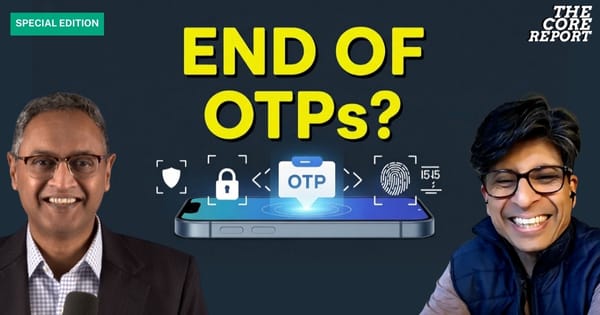
Will We Say Goodbye To OTPs In 2026? The Next Authentication Era
As India enters the next authentication era, this episode of The Core Report explores whether one-time passwords are finally reaching the end of the road and what could replace them when it comes to banking, payments, and everyday digital life.
In this special edition, Govindraj Ethiraj speaks with Pramod Varma, Co-Founder & Chief Architect at Networks For Humanity, Co-Creator of the FINTERNET & BECKN Protocol, architect behind Aadhaar, UPI, DigiLocker, eSign, Account Aggregator, and ONDC, to unpack how India’s digital public infrastructure is quietly moving beyond OTPs. From face authentication and biometrics to smartphone-based security, layered KYC, and verifiable credentials, they discuss why the current system feels broken and what a smarter, more inclusive model could look like by 2026.
✍️ Zinal Dedhia, Kudrat Wadhwa, Shubhangi Bhatia | ✂️ Rohini Chatterji | 🎧 Joshua Thomas
🤝 Reach 80k+ CXOs? Partner with us.
✉️ Got questions or feedback? Reach out.
💰 Like The Core? Support us.
