- The Core
- Posts
- India’s Ready-Cook Rush
India’s Ready-Cook Rush
Good Morning. For decades, Indian home cooks prided themselves on making everything from scratch. Today, changing lifestyles are fuelling a $1.1-billion read-to-cook market category in India and are pulling in fast-moving consumer goods giants ITC to Tata Consumer. But how will this FMCG industry category sustain?
India’s equity benchmarks fell for a third straight session on Tuesday. The BSE Sensex closed at 85,138.27, falling 503.63 points or 0.59%. The NSE Nifty50 closed at 26,032.20, losing 143.55 points or 0.55%.
In other news, Centre clarifies the Sachar Saathi app can be deleted. Meanwhile, in this week’s Build on Blockchain, a Korean company is using the technology to let K-pop fans have a piece of their favourite song.
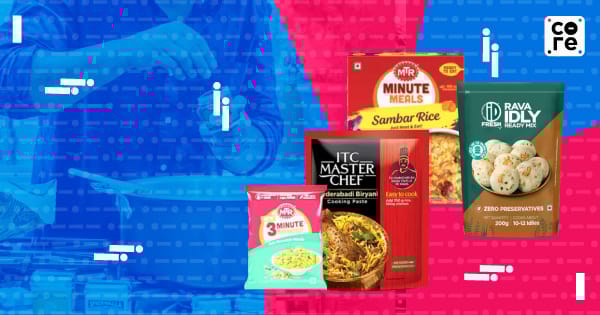
Why India's $1.1B Ready-to-Cook Boom Is Luring FMCG Giants, Startups
What?
Aarti Dethe, a homemaker, used to cook every meal from scratch. Now her kitchen staples include frozen fries and ready-to-cook batters for her five-year-old son, and sometimes even unexpected guests.
“I have a five-year-old son, and he asks for fries all the time… So, I buy frozen fries and keep them handy. It makes sense for me to unfreeze and heat. Also, when unexpected guests come in, it’s a boon,” she said.
She’s not alone. An estimated 50 million Indians now form the addressable market for pre-cooked and semi-cooked meals, according to a recent report by Redseer Strategy Consultants.
FMCG giants from MTR Foods to ITC, Godrej, Tata Consumer Products, Haldirams and Fortune have flooded the market with ready-to-eat (RTE) or ready-to-cook (RTC) options. The offerings range from cup noodles and biryani kits to marinated paneer and Thai chilli oil.
Regional brands and startups are carving out niches with healthier or specialised products.
Why?
“The growth of the RTE category is driven by busier lifestyles, higher disposable incomes, and rising comfort with packaged meals. Premiumisation, cleaner-label choices, and better cold-chain and packaging are supporting this shift,” Madhur Singhal, managing partner, consumer and internet at Praxis Global Alliance, told The Core.
RTE, which includes instant foods, baked goods, meats, and a wide range of ready meals, is set to expand at a 15-20% compounded annual growth rate from $1.1 billion in FY24 to over $3.4 billion by FY32, according to Praxis Global Alliance’s data.
“The category is benefiting from rising acceptance of convenience-led formats and higher trust in packaged foods,” added Mit Desai, practice leader, consumer and internet at Praxis Global Alliance.
Quick commerce has been a key accelerant for this segment, expanding the potential user base to around 70-80 million.
What Next?
Despite the rising number of buyers, this category remains unpenetrated. A Redseer survey found that only 4% of the people said that they consume RTC/RTE products on a daily basis, and another 8% consume 4-5 such meals a week. A major chunk – 23% of respondents say that they keep it to 2-3 meals a month.
“Companies have also innovated with long shelf-life products, like those which can stay for six months without refrigeration. The cold chain systems have also evolved over time, making frozen foods popular,” said Santosh Sreedhar, partner at Avalon Consulting.
According to Redseer, it is convenience and experimentation that are driving the market.
For now, most of the consumers are in big cities, but companies are eyeing smaller ones too.
Run ads IRL with AdQuick

With AdQuick, you can now easily plan, deploy and measure campaigns just as easily as digital ads, making them a no-brainer to add to your team’s toolbox.
You can learn more at www.AdQuick.com
Blockchain Turns On The Fan Mode For Hot K-Pop Tracks
What
K-pop or Korean pop music fans, who are spread across the world, aren’t just happy to listen to their favourite artists like BTS, BLACKPINK, Seventeen and Stray Kids, they now want to own a piece of it.
And guess what? They are likely to get it, thanks to blockchain.
The Korea Times reported last week that Aria Protocol, a Korean blockchain project, has launched a platform to fractionalise and trade music rights through blockchain.
They have put a catalogue of Korean music rights — reportedly amounting to about $100 million — on blockchain. This platform allows a fan to buy a small slice of a song’s rights and get a piece of what the song earns.
Although it’s a small number, it cannot be denied that it’s a path-breaking move.
Why It Matters?
The concept could come as a surprise to the industry because, traditionally, music rights are part of complex corporate contracts.
However, with blockchain, it would be easier to maintain ownership records. Using blockchain for ownership rights is a win-win for young artists as well, where early listeners can support them in a way that is more than cheering.
How can it be used in India?
This series is brought to you in partnership with Algorand India.
Join The Core at the 2025 Algorand India Summit in Bengaluru on December 6-7. Register today to discover how blockchain technology is helping transform access to finance. Register here.
Get Real Estate Training from Wharton Experts

Gain the skills top firms demand with the Wharton Online + Wall Street Prep Real Estate Investing & Analysis Certificate.
In 8 weeks, learn from leaders at Blackstone, KKR, Ares, and more while analyzing real deals.
Save $300 with code SAVE300 + $200 with early enrollment by January 12.
Air India Lapse
India’s aviation regulator has de-rostered several Air India executives after an Airbus A320 operated eight commercial flights with an expired airworthiness review certificate (ARC). The aircraft flew on November 24 and 25 despite its ARC expiring while it was grounded for an engine change, and Air India notified the DGCA only the following day.
Fast Facts: Post-merger, ARCs for all 70 Vistara aircraft were to be renewed directly by the DGCA. While 69 were cleared, the 70th aircraft’s ARC lapsed during maintenance, but was still released for service. The DGCA has grounded the aircraft and launched an investigation.
Outcome: Air India has been asked to audit its internal systems and implement corrective steps, amid heightened scrutiny following the fatal AI171 crash in June.
Energy Diplomacy Returns
Russian President Vladimir Putin begins a two-day India visit on Thursday, seeking to revive energy and defence ties as US pressure pushes Indian crude imports from Russia to a three-year low. Western sanctions on Rosneft and Lukoil have curbed supplies, but the Kremlin expects the dip to be temporary and plans to boost shipments.
Setting: Several refiners, including MRPL and HPCL, have halted Russian purchases, while Indian Oil Corp and Bharat Petroleum explore non-sanctioned suppliers. Putin, visiting New Delhi after four years, will meet Prime Minister Narendra Modi with a large defence and industry delegation, aiming to reaffirm the “special relationship.”
Context: Despite slowing oil trade, defence cooperation — from Sukhoi-30 jets to potential Su-57s and additional S-400 systems — remains the backbone of India-Russia ties.
Privacy Fights Erupts
Telecom Minister Jyotiraditya M Scindia has clarified that users can delete the Sanchar Saathi app from their device if they’d like, calling it a “voluntary and democratic system.”
Context: The Department of Telecommunications (DoT) issued an order on Monday that smartphone manufacturers pre-install the app on new devices sold starting March 2026. Unlike Scindia’s statement, the order says that smartphone makers ensure that the app’s “functionalities are not disabled or restricted.”
Flashpoint: Apple won’t be complying with the DoT’s order, sources have told Reuters. Opposition leaders are critical too: Congress member KC Venugopal called the directions “beyond constitutional,” calling the app a “dystopian tool to monitor every Indian,” in a post on X.
Rare Earth Breather
China has issued the first batch of streamlined export licences for rare earth materials, according to Reuters. A source told the publication that JL Mag Rare Earth, Ningbo Yunsheng and Beijing Zhong Ke San Huan High Tech have received these approvals.
Setup: The new general-licence system lets these companies ship to multiple customers without filing individual export requests, which speeds up supply chains. The move follows the recent Trump-Xi summit and signals a limited shift in China’s export posture.
Critical Moment: Indian manufacturers had earlier feared supply shocks when China tightened rare earth controls, especially in electronics and automotive sectors, as The Core previously reported. This easing may give them short-term relief, although China still keeps strict oversight on sensitive materials and end-uses.
India Inc Still Keeps Women Out
More than half the companies listed on the NSE employ under 10% women, according to Udaiti Foundation’s Close the Gender Gap dashboard. That means a majority of firms include fewer than one woman for every ten employees.
Context: The dashboard analysed over 2,000 NSE-listed companies and found that gender representation remains heavily skewed. A significant share of firms sit at the bottom of the diversity range, showing how uneven women’s participation still is across corporate India.
Critical Moment: Securities and Exchange Board of India norms and the Companies Act require companies to appoint at least one woman director, and most firms now comply. But the workforce numbers show that board-level mandates don’t automatically translate into wider representation. Without broader hiring and inclusion, companies struggle to move beyond minimal compliance.
Market Highs Slip Away
On Episode 741 of The Core Report, financial journalist Govindraj Ethiraj talks to Anindya Banerjee, Head, Research, Currency and Commodity at Kotak Securities and G Chokkalingam, Founder at Equinomics Research.
Market highs slip away.
Why is the rupee hitting new lows now?
What happens when markets hit peaks?
Will Russian oil come back? The IEW Segment.

✍️ Zinal Dedhia, Kudrat Wadhwa, Shubhangi Bhatia | ✂️ Rohini Chatterji | 🎧 Joshua Thomas
🤝 Reach 80k+ CXOs? Partner with us.
✉️ Got questions or feedback? Reach out.
💰 Like The Core? Support us.
