- The Core
- Posts
- India’s Airline Makeover
India’s Airline Makeover
In partnership with

Good Morning. India’s airlines are finally upgrading what passengers see and feel—not just what they fly. As Air India rolls out modern long-haul cabins and IndiGo inducts next-generation aircraft, in-flight experience is becoming a competitive lever. The key question now is on execution, and whether this capital-heavy bet can turn Indian carriers into credible global competitors.
In other news, markets weaken as nine of the top ten firms lose Rs 2.51 lakh crore. Meanwhile, the India–EU free trade pact could promise mutual gains.
Programming Note: The Core team is taking the day off on Monday, January 26, so there will be no edition of the newsletter on Tuesday, January 27. We will be back in your inboxes, on Wednesday, January 28.
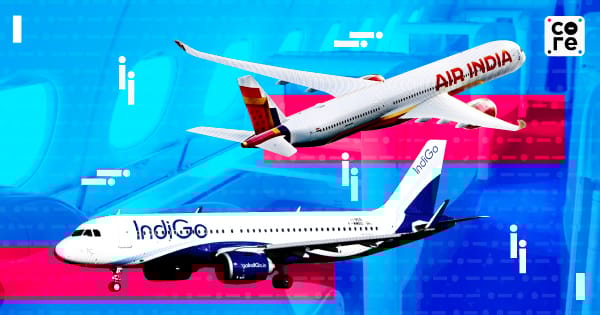
Cabin Upgrades Drive A New Phase Of Competition In Indian Aviation
What?
Multiple times last year, passenger videos of the poor conditions of Air India’s business class cabins went viral on social media. There was widespread criticism that for the airline to truly be the national carrier, it had to rehaul its ageing aircraft.
Cut to today, in-flight experience is finally taking centre stage for India’s airlines. IndiGo has taken delivery of India’s first A321XLR. Air India followed days later with its first 787‑9, both bringing refreshed cabins, upgraded seats, and a long‑haul product reset.
Indian aviation is finally shedding its legacy of dated cabins, key to passenger experience and business for the airlines.
Air India, long trapped in government‑era inertia, is now racing to modernise under private ownership, treating cabin upgrades as central to its brand revival. IndiGo, meanwhile, is using its new‑generation fleet to sharpen its onboard experience — cleaner, brighter, more ergonomic interiors that lift comfort without abandoning its low‑cost discipline.
Together, they signal a market where modern cabins are no longer optional but the new baseline for competitiveness.
Why It Matters
Cabin interiors matter far more than most people realise — they shape perception, comfort, loyalty, and even airline economics. Ageing cabins instantly erode trust, especially on long‑haul routes. When an airline upgrades its cabins, it isn’t just refreshing the look; it’s rewriting the passenger experience and its competitive position.
In a global market where travellers compare India’s airlines to their international counterparts, refreshed cabins aren’t cosmetic; they’re competitive survival. This is because passengers judge an airline by the seat they sit in, the space they get, the lighting they see, and the overall sense of modernity the moment they step onboard. If an Indian carrier’s cabin feels dated while a rival’s feels premium, the decision is made before take-off.

India Energy Week returns for its 4th edition from 27–30 January 2026 in Goa, held under the patronage of the Ministry of Petroleum & Natural Gas and co-organised by FIPI and DMG Events.
As India advances its role in the global energy transition, the event will bring together policymakers, industry leaders and innovators to shape practical pathways toward a secure, sustainable and affordable energy future.
IEW 2026 will spotlight India’s leadership in balancing energy access with decarbonisation, while showcasing strategic investments, emerging technologies and global partnerships driving the next era of energy progress.
The headlines that actually moves markets

Tired of missing the trades that actually move markets?
Every weekday, you’ll get a 5-minute Elite Trade Club newsletter covering the top stories, market-moving headlines, and the hottest stocks — delivered before the opening bell.
Whether you’re a casual trader or a serious investor, it’s everything you need to know before making your next move.
Join 200K+ traders who read our 5-minute premarket report to see which stocks are setting up for the day, what news is breaking, and where the smart money’s moving.
By joining, you’ll receive Elite Trade Club emails and select partner insights. See Privacy Policy.
Rs 2.51 lakh crore
That’s how much market capitalisation nine of India’s top ten most valuable companies lost last week. Reliance Industries took the biggest hit, with its valuation falling by nearly Rs 97,000 crore.
Here’s how the other major companies fared:
ICICI Bank lost Rs 48.6 thousand crore
HDFC Bank lost lost Rs 22.9 thousand crore
Bharti Airtel lost lost Rs 17.5 thousand crore
Tata Consultancy Services (TCS) lost Rs 16.6 thousand crore
Larsen & Toubro lost Rs 15.2 thousand crore
Bajaj Finance lost Rs 14.1 thousand crore
State Bank of India (SBI) lost Rs 11.9 thousand crore
Infosys lost Rs 7.8 thousand crore
Hindustan Unilever was the only exception, gaining Rs 12.3 thousand crore.
Implications: Analysts say that investors pulled back as market sentiment weakened sharply, with the Sensex sliding more than 2,000 points over the week and triggering broad-based selling. Shaky global markets added to the pressure, as overseas uncertainty spilled into Indian equities.
Foreign institutional investors stepped up selling, draining liquidity, while a weakening rupee reduced the appeal of Indian assets. At the same time, several large companies reported earnings that failed to meet expectations. Together, these factors pushed investors to book profits and cut exposure, dragging market capitalisation sharply lower.
A Win-Win FTA
The India–EU free trade agreement, set to be announced on January 27, is likely to lower costs and expand trade rather than threaten domestic industry, think tank Global Trade Research Initiative said. The two sides are partners operating at different points in the value chain, with India exporting labour-intensive, downstream goods and the EU supplying capital goods, advanced technology and industrial inputs.
Context: In FY2025, India–EU goods trade exceeded $136 billion. Indian exports such as smartphones, garments, footwear, pharmaceuticals and cut diamonds largely replace EU imports from third countries.
Setting: India’s $60.7 billion in imports from the EU are concentrated in high-end machinery, electronics components, aircraft, medical devices, chemicals and metal scrap—products India does not produce at scale and relies on to run factories, infrastructure projects and MSME clusters.
Big Auto Opening
India plans to sharply cut import tariffs on cars from the European Union to 40% from as high as 110%, in its biggest opening yet of the auto market as both sides near a free trade agreement that could be announced as early as Tuesday, Reuters reported.
Overview: The reduction would apply initially to a limited number of cars priced above €15,000. The duty is expected to be lowered further to 10% over time, easing access for European automakers such as Volkswagen, Mercedes-Benz and BMW. European carmakers hold under 4% of India’s 4.4-million-unit market.
Setup: India currently levies import taxes of 70% to 110% on cars, among the world’s highest. Battery electric vehicles will be excluded from duty cuts for five years to protect domestic investments.
Shift Away From Dollar
India’s holdings of US Treasuries have fallen to a five-year low as the country moves to support the rupee and diversify its foreign-exchange reserves, mirroring a broader shift by some major economies away from US government debt, Bloomberg reported.
By The Numbers: Holdings of long-term Treasuries dropped to $174 billion, down 26% from a 2023 peak, according to US data. Treasuries now make up about one-third of India’s reserves, versus 40% a year ago.
Impact: The shift reflects both currency-management needs and growing caution over dollar assets amid geopolitical risks. The Reserve Bank of India has sold Treasuries to fund rupee intervention as the currency hit record lows following delays to a US–India trade deal and steep US tariffs on Indian exports.
Meta Under Fire
Meta Platforms is facing an international lawsuit that accuses the company of misleading users about WhatsApp’s privacy protections.
Catch Up Quick: Plaintiffs from India, Australia, Brazil, Mexico and South Africa filed the case in a US federal court, claiming Meta can access, store and analyse WhatsApp messages despite advertising the service as end-to-end encrypted. The lawsuit alleges that Meta used these claims to grow WhatsApp’s user base while collecting data for commercial purposes.
Flashpoint: Meta has denied the allegations and described the lawsuit as frivolous. In India, the issue goes back to 2021, when WhatsApp’s privacy policy update led to court cases and an ongoing Competition Commission of India probe over whether users were pushed to share more data with Meta.
All the news that matters to your career & life

Hyper-relevant news. Bite-sized stories. Written with personality. And games that’ll keep you coming back.
Morning Brew is the go-to newsletter for anyone who wants to stay on top of the world’s most pressing stories — in a quick, witty, and actually enjoyable way. If it impacts your career or life, you can bet it’s covered in the Brew — with a few puns sprinkled in to keep things interesting.
Join over 4 million people who read Morning Brew every day, and start your mornings with the news that matters most — minus the boring stuff.
✍️ Zinal Dedhia, Kudrat Wadhwa, Shubhangi Bhatia | ✂️ Rohini Chatterji | 🎧 Joshua Thomas
🤝 Reach 80k+ CXOs? Partner with us.
✉️ Got questions or feedback? Reach out.
💰 Like The Core? Support us.