- The Core
- Posts
- India’s $10 Billion Deepwater Gamble
India’s $10 Billion Deepwater Gamble
In partnership with

Good Morning. India’s energy giants are embarking on a high-stakes strategy to break a record 88.4% import dependency on crude. While the Krishna-Godavari (KG) Basin is a proven powerhouse, the real gamble is in the ultra-deep Andaman Basin, a region being touted as India’s Guyana but currently sitting under 6,000 metres of water with zero proven reserves. Will this expensive gamble pay off?
India’s equity indices ended flat on Wednesday after two days of rallying. The BSE Sensex closed at 83,817.69, going up 78.56 points or 0.09%. The NSE Nifty50 closed at 25,776.00, gaining 48.45 points or 0.19%.
In other news, Anthropic’s AI launch triggers global selloff. Meanwhile, an on-ground account of commuting from Navi Mumbai airport tells us the systems aren’t as they should be.

Proven KG Basin to Iffy Andaman: A $10 Billion Gamble For Ultra-Deepwater Crude
What?
India's national oil companies are placing a high-stakes bet on the ocean floor that could have the potential to rewrite the country’s energy future, but could also turn out to be the most expensive campaign that didn’t yield results.
The companies are pursuing a two-track deepwater strategy ranging from extending proven production in the Krishna-Godavari Basin to high-stakes geological bets in the untested Andaman Basin.
The strategy is a tale of two basins. In the Krishna-Godavari (KG) Basin, the proof of concept already exists. The partnership between Reliance Industries and BP currently produces 28 million standard cubic meters of gas daily from the KG-D6 block. This single source accounts for roughly 30% of India’s total gas output, maintaining a staggering 99.9% uptime over 14 years.
Why It Matters
The urgency is driven by India’s energy reality. In the 2025 fiscal year, India’s dependency on imported crude climbed to 88.2%, up from 87.8% the previous year. The scale of capital now committed to offshore drilling suggests India is aiming for transformational finds.
To break this cycle, ONGC) and Oil India Ltd. are pivoting to depths exceeding 2,000 meters, where the risks are astronomical, but the rewards could be massive.
However, the real moonshot is the Andaman Basin. Geologists often draw optimistic parallels between the Andaman’s Tertiary-age structures and Indonesia’s legendary Sumatran fields, which have yielded nearly 28 billion barrels of oil equivalent since the 1970s. But geological analogies are not proven reserves.
In September, ONGC and Oil India signalled their intent by launching a Rs 3,200 crore ($385 million) stratigraphic drilling campaign. Working with BP, they are targeting four wells across the Andaman, Mahanadi, Saurashtra, and Bengal basins. Some of these targets sit beneath 6,000 meters of water and rock — commitments that dwarf any exploration effort since the iconic Bombay High strikes of the 1970s.
Oil India reported a natural gas occurrence at Vijayapuram-2 in September, prompting technology service agreements with TotalEnergies for wells at 2,000 metre water depths with total drilling approaching 7,000 metres. Even smaller operators are pushing offshore: HOEC's B-80 block produced 31,468 barrels in Q2 FY26, down 35% from Q1 due to monsoon disruptions.
The companies are making massive financial commitments for the ultra-deepwater bet.
ONGC invested nearly Rs 62,000 crore in capital expenditure during FY25, a significant increase from Rs 37,494 crore in FY24, while Oil India's consolidated capex was Rs 18,170 crore in FY25.
"We have been spending Rs 4000 crore per year on the data acquisition alone," ONGC chairman Arun Kumar Singh told The Core.

If you work in fintech or finance, you already have too many tabs open and not enough time.
Fintech Takes is the free newsletter senior leaders actually read. Each week, we break down the trends, deals, and regulatory moves shaping the industry — and explain why they matter — in plain English.
No filler, no PR spin, and no “insights” you already saw on LinkedIn eight times this week. Just clear analysis and the occasional bad joke to make it go down easier.
Get context you can actually use. Subscribe free and see what’s coming before everyone else.
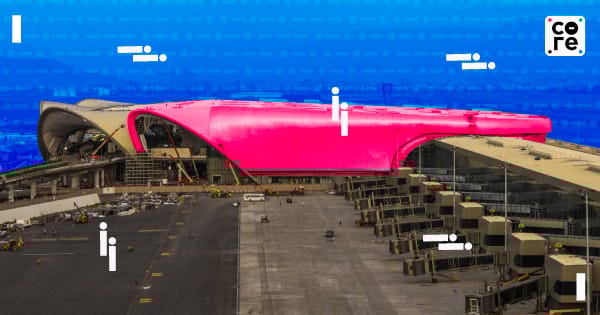
Navi Mumbai Airport Is Closer, But Has A Long Way To Go
Little can give as much glee as an airport that comes closer to your home. As a resident of Vashi, the new Navi Mumbai airport cuts travel time by around 30 minutes compared to
the Vileparle airport, which is more than an hour and a half away. During peak hours, it can increase to two hours. There were days when my point-to-point travel lasted over 12 hours, owing to bumper-to-bumper traffic and other hurdles.
Last week, when my husband had to board a flight from the newly inaugurated airport, I was beside myself when the cab company charged him only Rs 200 for the ride. That’s almost Rs 600-700 lower than what it would have cost to reach the Vileparle airport.
Network Jammed?
Later, when I landed in the same airport at around 8:30 am, I was comforted by the notion that I’d be home soon. However, the airport, shockingly, had little or no network, so we couldn’t book a cab on the app, as we waited for the luggage — something that is normal practice for most of us.
We had to reach the company cab area, and further chaos unfolded. There was a serpentine line of people waiting for cabs, all of whom had booked them a while ago.
The representative of the cab company was assigning cabs for people after checking the ‘type’ of cab they booked. I saw this practice at the Hyderabad airport too, wherein one has to simply book the cab, which would be assigned as we walk to the line. I always thought it was a smoother process.
There is no fleet of taxis waiting for customers either.
What about buses and autorickshaws? Yes, they’re missing in action too.
58.5
That’s the level India's dominant services sector rebounded to in January, as the HSBC Services PMI rose from December’s 11-month low.
Overview: International demand provided a significant boost, with export orders growing at their fastest pace in three months, led by markets like Indonesia and Qatar. This aligns with a brightening trade outlook following recent deals with the EU and lower US tariffs. However, inflation remains a concern; rising costs for food and electronics forced service providers to hike output charges to a three-month high.
Setup: Despite the surge in activity, the labour market remained lukewarm. Job creation hovered just above stagnation levels, barely recovering from December's contraction. Nevertheless, overall sentiment is positive: business confidence regarding the year-ahead outlook hit a three-month high, pushing the broader Composite PMI up to 58.4.
India-US Deal Hits Russia?
Russia’s oil revenues could come under further pressure if India continues to scale back purchases of Russian crude, as New Delhi’s diversification efforts threaten one of Moscow’s most important export markets, Reuters reported. The Kremlin said on Wednesday it saw nothing unusual in India’s recent comments on diversifying oil supplies, noting that New Delhi has long sourced crude from multiple countries, including Russia.
Backstory: Earlier, Union Commerce and Industry Minister Piyush Goyal stated that India is diversifying its energy sources to safeguard energy security amid global uncertainty.
Outcome: The remarks come as India’s Russian oil imports continue to decline. According to Reuters, imports fell in January by around 9%, extending a downturn that began in December, as refiners sought alternative barrels under Western sanctions pressure and amid US–India trade talks. On Monday, US President Donald Trump announced an India-US trade deal, claiming India would halt Russian oil purchases, though details are still awaited.
IT’s Moment Of Reckoning
Indian IT stocks fell 6.3% after US AI startup Anthropic launched plug-ins for its Claude Cowork agent, which automates tasks across legal, sales, marketing and data analysis. The selloff marked the NIFTY IT index’s worst day since March 2020, with Infosys sliding 7.3%.
Impact: The rout reflected a global sell-off in software and data stocks triggered by AI disruption fears, with firms like Kingdee in Hong Kong down double digits. Investors fear that automation could erode demand for labour-intensive services that underpin Indian IT’s model of deploying large teams to solve clients’ problems. Entry-level jobs in coding and routine support face the biggest threat.
Flashpoint: But, Nvidia CEO Jensen Huang called the idea that AI will replace software tools “illogical”, stressing that AI will enhance rather than destroy existing software, and that this truth will become clear with time.
Bengaluru Beckons Big Tech
As the US tightens immigration rules, including a proposed $100,000 fee on new H-1B visas, big tech is shifting more work to India. Alphabet has leased a large office complex in Bengaluru’s Alembic City and secured options for additional space, according to Bloomberg. A full build-out could house up to 20,000 employees, signalling a deeper move of engineering and operations to India.
Implications: The shift extends beyond offices. Apple launched its first education hub in India (also in Bengaluru) with Manipal Academy of Higher Education to train students, developers and supplier employees in digital and manufacturing skills.
Setting: India is positioning itself as the default global back office. On The Core Report, we noted that reports estimate that India could host over 2,400 global capability centres, a push reinforced by the Union Budget’s clearer tax rules and long-term certainty for GCC-led digital and cloud operations.
EVs, Slow But Steady
Electric two-wheeler volume growth in India is set to moderate to 12-13% this fiscal, down from about 22% previously, according to Crisil Ratings. The slowdown is attributed to temporary supply disruptions of rare-earth magnets from China and recent GST cuts on internal combustion engine (ICE) models, which narrowed the price gap.
Flashpoint: A significant market shift is underway, with legacy auto giants wrestling dominance from EV-only startups. The sector is expected to rebound to 16-18% growth next fiscal as supply chains stabilise and the structural advantage of lower running costs persists.
Future: Despite near-term hurdles, EV penetration is projected to rise to about 7% of total two-wheeler volume by next fiscal, with scooters leading the charge.
Why Markets Have To Reckon With Two Powerful Forces
On Episode 791 of The Core Report, financial journalist Govindraj Ethiraj talks to Abhishek Bisen, Head of Fixed Income, Kotak Mahindra AMC as well as Ajay Srivastava, Founder at Global Trade Research Initiative (GTRI).
Why markets have to reckon with two powerful forces
Why are the bond markets so volatile?
How will the India-US trade deal as we know it actually pan out?
Walmart crosses the $1 trillion mark
The Russia - India oil mix

✍️ Zinal Dedhia, Kudrat Wadhwa, Shubhangi Bhatia | ✂️ Rohini Chatterji | 🎧 Joshua Thomas
🤝 Reach 80k+ CXOs? Partner with us.
✉️ Got questions or feedback? Reach out.
💰 Like The Core? Support us.