- The Core
- Posts
- EU-phoria In Delhi, Heartburn In DC
EU-phoria In Delhi, Heartburn In DC
In partnership with

Good Morning. The India-European Union 'Mother of All Deals' is finally here, serving as a $136 billion buffer against Trump tariffs. While the legal fine print is yet to be set, it is already making America testy. With massive new quotas for European cars and a landmark defence partnership, this deal is as much about trade as it is about sending out a geopolitical message.
India’s equity indices closed on a high note on Tuesday. The BSE Sensex closed at 81,857.48, gaining 319.78 points or 0.39%. The NSE Nifty50 closed at 25,175.40, gaining 126.75 points or 0.51%.
In other news, Adani Group expands its aircraft manufacturing business. Meanwhile, on this week’s Build on Blockchain, could the technology help resolve property disputes faster, helping with court case backlog?
The India-EU ‘Mother Of All Deals’ Is Also A Geopolitical Message To Trump
India and the European Union (EU) have finally signed off on a free trade agreement after two long decades of discussions.
The deal may be signed, but even at this point, there is much legal scrubbing left to be done on both sides.
The whole process, including the ratification by various EU member states, could take another year, at least.
The timing is stark.
Both sides clearly want to cushion the impact of a new United States-led trade order where, increasingly, there is less order and more friction — at least regarding trade with Washington.
‘Mother Of All Deals’
The pact paves the way for freer trade in goods and services between the 27-nation EU and India, together representing a market of roughly 2 billion people.
While currently worth around $136 billion, bilateral trade is expected to surge under this "mother of all deals".
However, the agreement appears to be as much an immediate political signal as it is a long-term economic one.
Incidentally, the stockmarkets barely responded to the pact and were choppy and mostly indecisive on Tuesday. The reaction to a US trade deal with lower tariffs would have been quite different.
According to a trade lawyer who spoke to The Core, the non-trade components of the India-EU agreement carry more relevance.
The deal is anchored in a broader "Joint Strategic Agenda" that moves the relationship into the realms beyond where it is now.
Among key areas is Defence and Security, including a proposed formal Security and Defence Partnership — the EU’s first such move in Asia. Building on decades of technical collaboration, including the recent launch of the Proba-3 mission and leveraging the 2022 launch of the India-EU Trade and Technology Council to coordinate on digital and green standards.
As part of the deal, India will also give European automakers a quota six times larger than India has ever offered before.
The signals are being sent as much to the United States as they are to domestic audiences in Brussels and Delhi.
Washington Turns Testy
All eyes are now on Washington to see how it will react, and the first signs are far from positive.
US Treasury Secretary Scott Bessent has already criticised the EU for forging ahead with the deal.
“The US has made much bigger sacrifices than Europeans have. We have put 25% tariffs on India for buying Russian oil. Guess what happened last week? The Europeans signed a trade deal with India,” Bessent told ABC News Sunday.
The US ability to keep global and local nerves frayed is remarkable, though what this "maximum pressure" achieves remains unclear.
India’s Minister of Petroleum and Natural Gas, Hardeep Singh Puri, offered a cooler perspective to CNBC on Tuesday, stating he expected the US-India relationship to remain positive.
“I don’t know when trade deals will get signed... but everybody needs to chill a bit,” he said.
If only the Trump administration would heed that advice.


India Finance & Innovation Forum 2026 convenes policymakers, regulators, financial institutions, and industry leaders at a moment when India’s financial architecture is being actively reshaped. Over three days, the Forum will focus on fiscal and monetary priorities, capital markets, digital finance, and innovation-led growth—grounded in real-world challenges and institutional decision-making.
Designed for senior decision-makers, IFIF 2026 combines on-stage dialogue with curated networking, innovation labs, and collaborative working sessions. The focus is on understanding what is changing, what is working, and what comes next for India’s financial system.
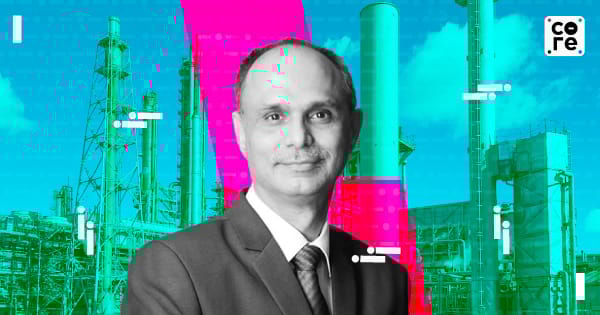
BPCL Turns Refining Efficiency Into Its First Climate Strategy
There may be a narrative of oil being a sunset industry. But state-owned Bharat Petroleum Corporation Limited (BPCL) is instead positioning it as a cornerstone of a multi-fuel ecosystem focused on rapid decarbonisation.
Speaking on the company's strategic evolution since COP 26, Sanjay Khanna, Director of Refineries, told The Core in the run-up to India Energy Week about a transition where traditional fossil fuels and emerging green energies do not just compete but coexist to meet India’s growing demand.
Efficiency In The Core
The company’s first line of defence against emissions remains its refining operations. Khanna noted that significant gains are being made simply through operational "trimming" and improving the efficiency of existing infrastructure.
"We know that 10 to 15% energy reduction possibility is there by just by trimming by taking the action and reduction of the fuel or improving the efficiency of the refineries," Khanna stated.
These efforts were recently validated by a Solomon Benchmark study, which confirmed a significant reduction in emissions across BPCL refineries over the past year.
The Ethanol Milestone
BPCL has also hit a critical target in biofuel adoption. For the last two months, the refiner has consistently achieved a 20% ethanol blending rate, a key government mandate. This success is supported by the commissioning of a 1G plant at Bargarh, with a 2G plant expected to come online as early as this month.
Khanna emphasised that the shift in the energy landscape requires a responsible approach to CO2 emissions, making decarbonisation a topmost priority for the firm.
This series is brought to you in partnership with India Energy Week 2026.
How Blockchain Could Ease Land Dispute Backlogs, And Why Apex Court Agrees
What?
Land and property disputes continue to dominate India’s civil courts. Nearly two-thirds of civil cases and over a quarter of Supreme Court matters relate to ownership and title conflicts.
Studies cited by Down to Earth in a December 2025 article show that land and property litigation has blocked assets worth crores of rupees, freezing household wealth and stonewalling development projects.
On January 22, the Supreme Court urged the Union and state governments to urgently digitise registered documents and land records using blockchain, which can ensure transactions are secure and nobody can tamper with land records.
The court observed that technological intervention is necessary to prevent recurring property disputes and to preserve the sanctity of registered instruments.
Why?
That can be achieved if the transactions are recorded on the blockchain, “minimising the scourge of forgery and ‘clever drafting’ that clogs our judicial system”.
A registered sale deed, the court said, “carries a strong presumption of validity, and allegations that such a document is a sham or nominal transaction cannot be entertained in the absence of clear pleadings and cogent evidence.”
If ownership were logged into a system that couldn’t be changed by anyone — be it a clerk or someone with influence — courtroom disputes wouldn’t take long to resolve.
In fact, more cases would be settled without any legal intervention.
This series is brought to you in partnership with Algorand India.
$500 billion
That’s how much investment India’s energy infrastructure has the potential for, according to PM Modi, who cited this figure in his video address at the India Energy Week conference. He framed it as part of India’s push for energy independence.
In the same speech, Modi said India is targeting $100 billion in oil and gas investments by the end of the decade, and aims to expand refining capacity beyond 300 million tonnes per year, up from roughly 260 million tonnes today. He also said the government wants LNG or liquified natural gas to account for around 15% of India’s energy mix, flagging investment opportunities across the gas value chain, from import terminals to pipelines and transport vessels.
Context: Government and industry data show that India’s import dependence for crude oil is around 80-85%, meaning roughly four out of every five barrels it consumes come from abroad rather than domestic fields. That dependence has geopolitical costs. Under US President Donald Trump, Washington levied an additional 25% tariff on Indian exports, explicitly linking trade penalties to India’s energy relationship with Russia.
Impact: Modi’s announcement also complicates India’s clean-energy narrative. While India has pledged to reach net zero emissions by 2070, the investment push includes fossil fuel infrastructure such as LNG. The push highlights a central tension in India’s energy strategy: balancing climate commitments with the realities of demand and geopolitics.
Adani–Embraer Aviation Play
India’s Adani Group and Brazil’s Embraer have signed a pact to set up a regional transport aircraft venture in India, marking Adani’s entry into commercial aviation manufacturing and aligning with India’s ambition to expand aircraft production beyond assembly into components, supply chains and services.
Flashpoint: The companies signed a memorandum of understanding covering aircraft manufacturing, aftermarket services and pilot training, without disclosing financial details. Embraer has been seeking to deepen its India presence following earlier defence collaborations. However, scaling manufacturing will require parallel investment in maintenance infrastructure.
What's Next? The Adani–Embraer partnership focuses on Embraer’s 70–140 seat E-Jet and E2 regional aircraft, designed for short- to medium-haul routes, UDAN connectivity and Tier-2/Tier-3 markets, positioned below the Airbus A320 and Boeing 737 and competing most closely with the Airbus A220. The Core reported that India is expanding fleet capacity faster than it is building hangars and MRO facilities, forcing airlines to send aircraft abroad for heavy maintenance and exposing a critical gap in the aviation ecosystem.
Asia’s Power Pivot
In 2025, India and China cut emissions from electricity generation even as power demand rose, while US power-sector emissions increased, according to analysis by the Centre for Research on Energy and Clean Air (CREA).
The Turning Point: China’s electricity emissions fell 0.7% year on year, while India recorded a sharper 4.1% decline, as rapid additions of solar and wind met most new demand and limited coal use. The US moved in the opposite direction. Coal-fired power generation rose 13.1%, the fastest increase this century, pushing electricity emissions higher.
What This Means Going Forward: In 2025, India increased its electricity supply without increasing power-sector pollution, a rare outcome for a fast-growing economy. The data shows that renewables are beginning to replace coal generation as demand rises, rather than merely adding new capacity alongside it.
The headlines that actually moves markets

Tired of missing the trades that actually move markets?
Every weekday, you’ll get a 5-minute Elite Trade Club newsletter covering the top stories, market-moving headlines, and the hottest stocks — delivered before the opening bell.
Whether you’re a casual trader or a serious investor, it’s everything you need to know before making your next move.
Join 200K+ traders who read our 5-minute premarket report to see which stocks are setting up for the day, what news is breaking, and where the smart money’s moving.
By joining, you’ll receive Elite Trade Club emails and select partner insights. See Privacy Policy.
Stop Drowning In AI Information Overload

Your inbox is flooded with newsletters. Your feed is chaos. Somewhere in that noise are the insights that could transform your work—but who has time to find them?
The Deep View solves this. We read everything, analyze what matters, and deliver only the intelligence you need. No duplicate stories, no filler content, no wasted time. Just the essential AI developments that impact your industry, explained clearly and concisely.
Replace hours of scattered reading with five focused minutes. While others scramble to keep up, you'll stay ahead of developments that matter. 600,000+ professionals at top companies have already made this switch.
✍️ Zinal Dedhia, Kudrat Wadhwa, Shubhangi Bhatia | ✂️ Rohini Chatterji | 🎧 Joshua Thomas
🤝 Reach 80k+ CXOs? Partner with us.
✉️ Got questions or feedback? Reach out.
💰 Like The Core? Support us.