- The Core
- Posts
- Air India Crash: All For Nothing?
Air India Crash: All For Nothing?
In partnership with

Good Morning. The Air India crash in June left all of us shocked. While the full result of the probe is yet to come, there has already been much scrutiny and outrage, and promises made by authorities. For once, it felt like India’s aviation system might finally pause and rethink how it is regulated. As the year ends, very little seems to have changed on the ground.
India's equity benchmarks ended without much change on Tuesday. The BSE Sensex closed at 84,675.08, falling 20.46 points or 0.02%. The NSE Nifty50 settled at 25,938.85, down by 3.25 points or 0.01%.
In other news, Russian crude to India is set to fall to a three-year low. Meanwhile, on this week’s Build on Blockchain, could the technology help with verification without personal details like birthdates?

The Air India Crash Triggered Scrutiny, But Failed To Usher In Structural Reform
What?
For days after the Air India crash on June 12, 2025, the tragedy dominated headlines with political statements and regulatory briefings.
Images of wreckage, emergency responders, and grieving families put the spotlight back on India’s aviation regulation and raised questions about safety oversight, regulatory vigilance, and whether India’s aviation system had grown faster than its ability to govern itself.
As the year draws to a close, the shock has faded. Flights are full again, schedules are stretched, and airlines are back to competing fiercely on fares and market share. However, the crash triggered a series of responses — some visible, some procedural, some still contested — that offer a snapshot of how India reacts to aviation crises.
While much was said, experts believe that the crash did not lead to any meaningful regulatory change in the industry.
“There were no immediate safety protocols announced, neither by the regulator nor by the airline. Nothing has changed after the crash. We are still exactly where we were before. That is the most disturbing part. Nothing has moved, and there appears to be no urgency,” Mark Martin, aviation expert, told The Core.
Why?
Within hours of the accident, the aviation regulator, the Directorate General of Civil Aviation (DGCA), took charge. Standard crisis protocols were activated: a formal investigation was ordered, safety inspectors were dispatched, and the airline was asked to submit detailed documentation covering maintenance records, crew rostering, and operational procedures. A fleet-wide review of aircraft of the same type involved in the crash was also initiated.
In the days that followed, the regulator issued a checklist of compliance requirements and ordered additional inspections. Multiple spot audits were carried out, including surprise checks at major airports. Airlines were asked to submit compliance reports within compressed timelines.
But for critics, the speed of the response masked a deeper concern.
“The regulator’s response is knee-jerk. The checklist issued a day after the crash could just as well have been issued a day before,” Aurobindo Handa, former investigator with the Aircraft Accident Investigation Bureau (AAIB), told The Core.
What's Next?
Despite months of heightened activity, one reality stands out as the year ends: India’s aviation rulebook remains fundamentally unchanged.
No new safety regulations were notified. No binding operational limits were rewritten. The DGCA did not introduce fresh statutory norms on crew duty hours, maintenance intervals, or oversight powers beyond what already existed. Instead, most post-crash action took the form of advisories, audits, and stricter enforcement of existing provisions.
Several officials privately acknowledge that the regulator relied on powers it already had. Enhanced inspections, additional reporting requirements, and temporary checks were carried out under existing frameworks. In effect, the system intensified, but it did not evolve.
Industry executives note that airlines were asked to be more careful, not fundamentally different. Safety management systems, which were already mandatory before it. Maintenance oversight norms were reiterated, not rewritten.
If heightened vigilance fades without new rules or accountability, how prepared is India’s aviation system for the next crisis?
Fuel your business brain. No caffeine needed.

Consider this your wake-up call.
Morning Brew}} is the free daily newsletter that powers you up with business news you’ll actually enjoy reading. It’s already trusted by over 4 million people who like their news with a bit more personality, pizazz — and a few games thrown in. Some even come for the crosswords and quizzes, but leave knowing more about the business world than they expected.
Quick, witty, and delivered first thing in the morning, Morning Brew takes less time to read than brewing your coffee — and gives your business brain the boost it needs to stay sharp and in the know.
What’s Your Age? Say It Without Revealing The Birthdate
What?
Whether it is an insurance policy, a financial product, or a digital service, there is a common request: share your date of birth. Often, that detail is presented along with other identity information and gets stored somewhere.
However, there is a way to verify information for an individual without giving out personal details. It’s called zero-knowledge proof (ZKP), a cryptographic tool that works with blockchain technology.
How Does It Work?
The idea is to prove that something is true without revealing how and why it is true. The verifier gets a system-triggered green light, and the person proving it gets to keep the specific details to himself.
With ZKPs, a person can prove that they meet the required age threshold without revealing a date, says blockchain and AI expert Nikhil Varma of Algorand.
In a recent LinkedIn post, Varma wrote: “The core idea of a zero-knowledge proof is proof without disclosure. It's a way to verify information without revealing the information itself.”
A system like this already exists for European Union (EU) citizens, residents and businesses, and it’s called EU Digital Identity Wallet.
Could India implement this too?
This series is brought to you in partnership with Algorand India.
152.6 million
That’s how many passengers India’s domestic airlines carried between January and November 2025. The figure is up from 146.4 million passengers a year ago, translating into 4.26% year-on-year growth and 6.92% month-on-month growth, according to the latest data from the Directorate General of Civil Aviation (DGCA).
Backdrop: Demand held steady through November, with all major airlines posting higher passenger load factors (PLFs)—a key measure of how full planes are. IndiGo remained the market leader despite a slight dip in share to 63.6%, while Air India Group’s share rose to 26.7%. Akasa Air and SpiceJet saw marginal shifts. Capacity utilisation improved sharply: Air India’s PLF jumped to 87.5% from 77.3% in October, IndiGo’s rose to 88.7%, and Akasa Air topped the chart at 93.8%.
Pivot: The momentum may not carry into December. IndiGo, the country’s largest carrier, faced a major operational disruption triggered by the rollout of new crew rest (FDTL) rules, leading to thousands of flight cancellations and affecting lakhs of passengers.
Crude Flows Ease
Russian crude oil flows to India are set to fall to a three-year low in December, though volumes may rebound early next year after Reliance Industries Ltd. resumed purchases, Bloomberg reported. Deliveries are expected to average about 1.1 million barrels a day this month, the lowest since November 2022, according to shipping data tracked by Kpler.
Setting: Imports dipped as Indian refiners navigated tighter US scrutiny of Russian energy trade. Shipments fell sharply in July before recovering modestly as state-run refiners such as Indian Oil Corp. and Bharat Petroleum Corp. returned to buying discounted barrels.
Context: Reliance, India’s largest private refiner, had paused purchases after US sanctions on Rosneft and Lukoil in late October but has now resumed sourcing from non-blacklisted suppliers. Additional support could come from Nayara Energy, which may delay maintenance at its Vadinar refinery, potentially lifting Russian crude intake early next year.
Growth Finds Footing
India’s industrial outlook remains supported by easing financial conditions and policy relief, even as external risks linger. Industrial production surged to a 25-month high of 6.7% year-on-year in November 2025, rebounding sharply from 0.5% in October, led by manufacturing, mining and both investment- and consumption-oriented goods.
Setup: Cyclical support from a good monsoon, lower inflation and interest rates, along with GST rationalisation, should help cushion risks from a weak global environment, QuantEco Research said.
Overview: Crisil added that income-tax cuts and GST rate rationalisation are expected to lift discretionary spending, while benign inflation—averaging 1.8% so far this fiscal—creates room in household budgets. However, slower exports due to US tariffs and easing government capex could temper momentum.
IPO Red Flag
FMCG distributors' body, the All India Consumer Products Distributors Federation (AICPDF), said on Tuesday that it has written to India’s markets regulator, the Securities and Exchange Board of India (SEBI), asking it to halt IPOs of loss-making quick commerce companies. The body said that while private investors gain from these IPOs, the long-term financial risk is “transferred to retail and small public investors”.
The Context: “Loss-making companies pursue aggressive cash-burn strategies to acquire market share and subsequently access public markets through IPOs that are heavily skewed toward Offer-for-Sale components,” the press release said. This comes even as quick commerce company Zepto filed for an IPO worth $1.22 billion earlier this week.
Why It Matters: AICPDF said India’s kirana sector was under tremendous stress. Dhairyashil Patil, national president of the AICPDF, said, “Predatory pricing funded through investor money is destroying lakhs of kirana livelihoods. SEBI has a constitutional responsibility to ensure transparency, fairness, and investor protection. We urge the regulator to intervene decisively before irreversible damage is done to both investors and India’s retail ecosystem.”
Public Banks Take Lead
Private sector banks cut staff in FY25, while public sector banks (PSBs) recorded a marginal rise in employee numbers, according to data published by the Reserve Bank of India (RBI).
By the Numbers: Private banks reduced headcount by more than 7,000 employees during the year, largely due to job cuts at large lenders amid higher use of digital banking and tighter cost control. PSBs added about 1,600 employees, while small finance banks continued to expand their workforce.
Setup: The hiring trend comes as PSBs report stronger performance in recent years, supported by lower bad loans, improved capital positions and steady credit growth. Private banks, despite healthy profits, have focused on efficiency and productivity gains, leading to slower hiring and workforce rationalisation.
Daily News for Curious Minds
Be the smartest person in the room by reading 1440! Dive into 1440, where 4 million Americans find their daily, fact-based news fix. We navigate through 100+ sources to deliver a comprehensive roundup from every corner of the internet – politics, global events, business, and culture, all in a quick, 5-minute newsletter. It's completely free and devoid of bias or political influence, ensuring you get the facts straight. Subscribe to 1440 today.
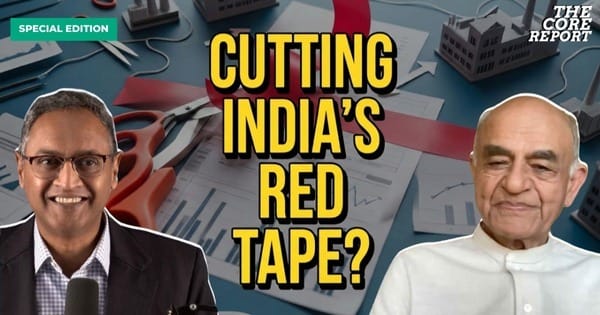
Is 2026 India’s Biggest Reform Moment Since 1991? Gurcharan Das Explains
In today’s The Core Report Special Edition, financial journalist Govindraj Ethiraj speaks to author and commentator Gurcharan Das on whether 2026 could become India’s biggest reform moment since 1991 and if the country can finally cut red tape, boost manufacturing, and create jobs at scale.
As US tariffs and global trade shifts reset supply chains, India has responded with measures such as GST reform, labour codes, easing non-tariff barriers, and adjustments to quality control orders. But the deeper question remains. Why did India grow strongly after the 1991 economic reforms, lift millions out of poverty, and still struggle to create enough factory jobs, exports, and global manufacturing leaders?
✍️ Zinal Dedhia, Kudrat Wadhwa, Shubhangi Bhatia | ✂️ Rohini Chatterji | 🎧 Joshua Thomas
🤝 Reach 80k+ CXOs? Partner with us.
✉️ Got questions or feedback? Reach out.
💰 Like The Core? Support us.
